A Sunday Table Set for the Week Ahead
A Sunday table reset helps you choose one priority, make shared plans visible and return the surface to daily use without turning it into another task.
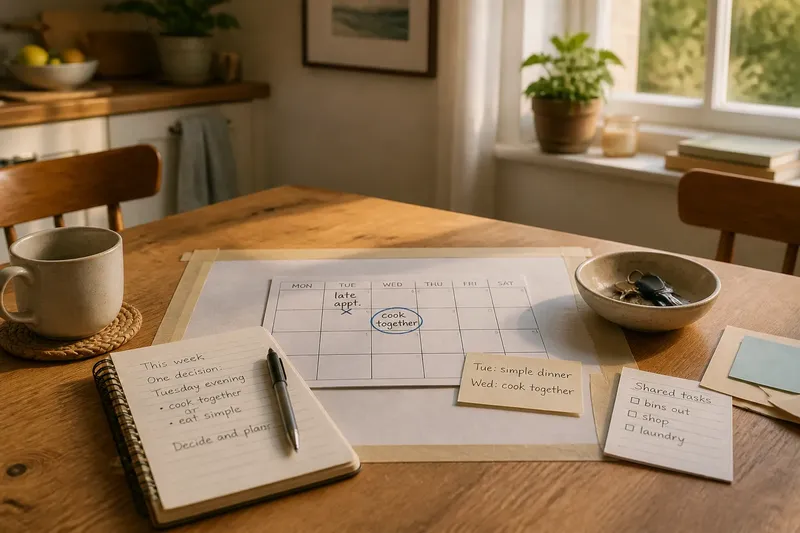
A Sunday table reset is useful when it settles one real question about the week, rather than asking the household to perform calm. Clear a small part of the table, put down only what helps with that decision, and leave the rest of the room alone. The point is not to make a domestic display; it is to turn a vague intention into something the people affected can recognise.
Make the Sunday table reset answer one question
Choose a question with a practical consequence: which evening needs an easy meal, what commitment can be deferred, or when will a shared task happen? A general wish to “be more organised” gives the table nothing specific to hold. One answer, even a provisional one, can change how the week is arranged.
Use the surface that already belongs to ordinary life: the kitchen table, a corner of the dining table or a cleared patch of a worktop. If the table is shared, claim only the space you need. A strip of masking tape on a sheet of paper can mark the temporary working area; unlike a permanent display, it comes away when the pause ends.
Choose objects that make the decision visible
Bring objects for a reason, not for atmosphere. A notebook can capture a commitment, a paper calendar can expose a clash, and a bowl can collect the keys or note that must leave the house. If an item does not help you decide, remember or act, set it aside.
Keep unrelated chores out of the ritual. An unopened envelope may need attention, but sorting the post can become a different task and crowd out the question you sat down to answer. Put it in a separate place and return to it later.
- Calendar: Check whether the chosen commitment conflicts with an existing appointment; if it does, move the commitment or discuss another time, and if it does not, mark it clearly.
- Notebook and pen: Check whether the intention can be written as a specific action; if it can, record the action and its cue, and if it cannot, narrow the intention before writing it down.
- Keys or travel card: Check whether an errand depends on taking them; if it does, place them by the door after the reset, and if it does not, keep them in their usual place.
- Meal note: Check whether a planned evening needs a simpler dinner; if it does, choose a familiar meal and note any missing ingredient, and if it does not, leave the meal plan unchanged.
- Shared task list: Check whether another person is affected by the task; if they are, agree who will do what or revisit the plan together, and if they are not, keep the task on your own list.
- Loose paper: Check whether it supports the decision in front of you; if it does, keep it on the working area, and if it does not, return it to its proper place or set it aside for later.
Let different needs lead to different versions
A shared household does not need one shared ideal of a good week. Ask each person affected for one practical need, then look for a decision that can accommodate them without turning the conversation into a vote on everyone’s priorities. One person may need a quiet evening while another wants time together; naming the tension is more useful than promising that the week will somehow feel balanced.
For children, offer a bounded choice: choose between two meals, pick a book for a shared reading moment, or decide where sports kit should wait. This gives them a clear say without making them responsible for the whole household schedule.
If Sunday is already full, use a different recurring pause, such as Saturday breakfast or a quiet moment before the first workday. The day matters less than having enough attention to make one choice and enough time to put the objects away afterwards.
How can a Sunday table reset fit real household needs?
What should go on the table?
Start with a calendar or notebook and add only an object tied to the decision. A candle or decoration is optional; leave it out if arranging it becomes another obligation.
What if people disagree about the week?
State the competing needs plainly and find the smallest point that needs agreement, such as one evening’s plan or who handles a task. If no agreement is possible in the moment, record what remains undecided and choose a time to return to it.
What if the table is already in use?
Use a clear corner, a placemat or a sheet of paper as a temporary boundary. If even that would interfere with someone else’s work or meal, use a notebook elsewhere rather than displacing them.
Does every week need a written plan?
No. If one clear decision is already understood, a brief conversation may be enough. Write something down when it helps people remember or act; otherwise, put the objects away and carry on.
Work through one decision from start to finish
Imagine you live with a housemate, and both of you have a busy Tuesday evening. The calendar shows that you had pencilled in cooking together, while your housemate has an appointment that ends late. You put the calendar, a pen and a scrap of paper on the table, then ask whether the shared meal or an unhurried evening matters more this time.
Your housemate says they would rather eat later without rushing; you would still like to share food. You move the meal to Wednesday, write “cook together” beside that evening, and note that Tuesday dinner will be separate and simple. The resulting trade-off is visible: you keep the shared meal, but not on the original night. If Wednesday later fills up, the note gives you a specific plan to reconsider rather than a vague promise to find time.
End the pause without leaving a display behind
Before standing up, give every object a destination. Put the calendar back, carry the note to the place where it will be used, and return keys and papers to their usual homes. If a decision is unresolved, write down the next conversation or check needed; do not leave loose objects on the table as a substitute for remembering.
A Sunday table reset should make the chosen priority easier to act on while keeping the surface available for its ordinary work. The best measure of the ritual is not how composed the table looks afterwards, but whether the next person who needs it can use it without first clearing away your intentions.