The Keepsake Box Myth: Sentiment Does Not Require Keeping Everything
Keepsake box decisions can honour a memory without preserving every object. Find practical ways to choose, document and release sentimental belongings.
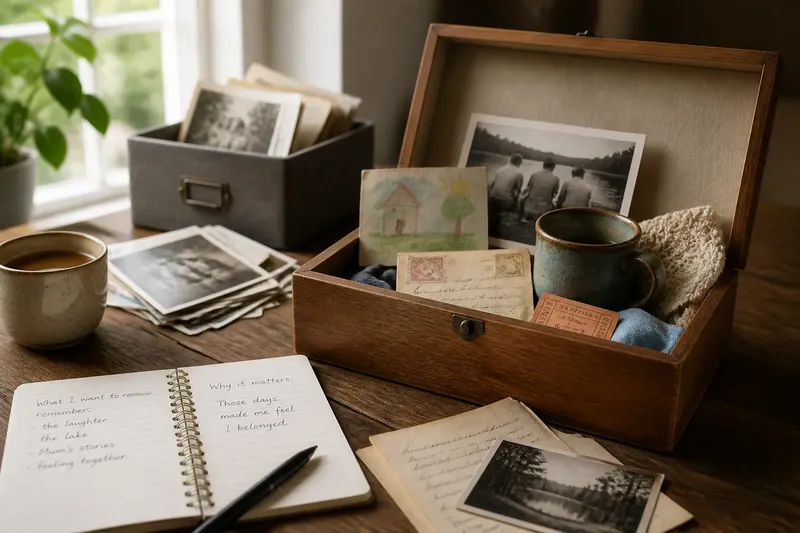
A keepsake box can hold a memory, but it cannot hold every memory well. Keepsake box decisions become difficult when an object seems to carry the whole meaning of a person, place or time. Letting it go can feel like denying what mattered. Yet the memory is not stored inside the object alone; it also lives in what you recall, tell and continue to value.
The trouble is that sentimental belongings rarely arrive with clear instructions. A child’s drawing, a ticket stub or a relative’s chipped mug may each seem to deserve a place. The answer need not be to discard them all, or to keep them all. It is to understand what is making a particular choice hard, then choose a form of remembrance that fits the meaning and the space available.
Keepsake box decisions work best when the object has a clear role
Some objects matter because they are useful reminders. Others are valuable because of their appearance, or because they connect several people to a shared history. Trouble starts when “this is sentimental” becomes the only reason for keeping something. That description says how you feel, but not what you want the object to do in your life.
Try finishing one of these sentences: “I keep this because I like to see it,” “I use it to remember…”, or “I want to share its story with…”. If none feels true, the object may be carrying an obligation rather than a living connection. That does not make the feeling false. It gives you a more useful question than asking whether the item is important enough.
A keepsake box is like a small bookshelf: its limits can help you choose what belongs there. The limit is not a verdict on the memories outside it. It is a way to make the selected objects easier to find, protect and revisit.
Fear of forgetting can make every object feel irreplaceable
One common difficulty is the thought, “If I let this go, I will forget.” It often appears when an object is the only visible trace of a person or event. A faded note may seem to contain a voice; a souvenir may stand in for a trip whose details have grown blurred.
What usually causes the fear is not the item’s rarity but the sense that the memory has no other home. Before deciding, ask what you want to remember specifically. Is it a phrase, a place, the way someone used the object, or the feeling of being there? Name that detail in a caption, a letter to yourself or a conversation with someone who shares the memory.
Say you have a paper admission ticket from a family outing, and you are anxious that recycling it will erase the day. You could write down the place, who came along and one small moment you still picture, then keep the note with a photograph if one exists. The expected result is not a perfect substitute for the ticket; it is a memory you can revisit without relying on a fragile scrap of paper.
Guilt about the giver can disguise a sense of duty
A gift can become difficult to release because it seems to represent the giver’s care. Keeping it may feel like a promise, even if it does not suit your home or life. The object then carries two separate things: the relationship, and the practical decision about whether you want to own it.
Try separating those ideas. You can appreciate the thought behind a gift and still decide that the item has finished its place with you. If the relationship is active, you might tell the giver what you enjoyed about receiving it, without making a report of every later possession decision. If a conversation is needed, speak about your space and habits rather than judging the gift.
There are also cases where an object is genuinely useful to another person. Passing it on can let its practical life continue, while the affection attached to the gift remains part of your history. That choice is not a test of gratitude; it is a decision about what form the gratitude takes now.
Family disagreement can turn shared history into a private burden
Objects inherited or kept for a family can prompt a different problem: one person feels responsible for preserving what others remember too. A box of photographs, letters or household pieces may have several owners in people’s minds, even when only one person is storing it. Silence can leave that person carrying both the things and the uncertainty.
Start by identifying which objects have a clear shared significance and who may want to help decide. Ask relatives about particular items rather than sending a broad question about everything. A specific prompt—such as whether anyone has a memory of a labelled photograph—makes it easier for people to respond. Set a reasonable point to revisit the decision, so that “someone might want this” does not become permanent storage by default.
For material that is genuinely shared, agree on a custodian or a way to divide it. A scan can make a family image accessible to several people, but it does not settle ownership of an original letter or heirloom. If legal ownership or a dispute matters, seek advice from a qualified professional rather than treating a family arrangement as a legal answer.
Too many photographs can preserve clutter in another form
Taking a photograph of every object may seem like an easy compromise. It can help with items whose appearance matters, but it can also move the burden from a cupboard to a camera roll. A picture without context may leave you wondering who owned the object or why you saved its image.
Be selective about what a photograph would preserve. Photograph a handmade object if its details are part of the memory; write a short caption if the story matters more than the shape. You might record the maker, the occasion and one detail you would otherwise lose. If the digital copy has no likely use or meaning, making it may only postpone the decision.
Digital files still need a place where you can find them. Add a plain-language name or caption and keep the image with related photographs or notes. Follow the storage service’s instructions for backups and access, especially if the file matters to more than one person. The goal is a usable record, not a second archive that grows without choice.
Which keepsakes should stay, and what can replace them?
How do I choose what belongs in a keepsake box?
Choose objects you want to see, use or share, rather than items you feel you must defend. Give the box a boundary that suits your home, then select the pieces that carry distinct memories instead of several objects that tell the same story.
Is it wrong to let go of a family heirloom?
Not necessarily. Consider whether someone else values or can use it, and whether the item has a clear family owner before passing it on. A meaningful connection does not require every relative to store the same object.
Can a photograph replace a sentimental object?
Sometimes, if the object’s appearance is what you want to remember. A photograph will not preserve its texture, use or full story, so add a caption or spoken account when those details matter more.
What if I feel uncertain after deciding?
Uncertainty is not proof that the decision is wrong. If the choice is reversible, set the item aside temporarily and decide again after you have had space from it; if it is not, pause long enough to name the specific memory you want to keep.
Make the decision in an order that reduces regret
When a sentimental object stalls you, work through the problem in sequence rather than sorting by category alone:
Name the connection. Write a few words about the person, event or feeling the object brings to mind.
Identify the object’s role. Decide whether you want to use it, display it, share its story or simply feel obliged to retain it.
Look for another form of remembrance. Consider a note, a conversation, one carefully captioned photograph or a related object you already value.
Ask who else is involved. Contact the relevant person if the item is shared, inherited or likely to matter to someone else.
Choose a next action. Keep it with a reason, document its story, offer it to someone who wants it, or let it leave your home.
Where handling, ownership or disposal depends on a maker’s instructions, a label or local rules, check those before acting. That is a practical boundary, not a reason to keep an unrelated object indefinitely.
The keepsake box myth is the belief that care can be measured by how much remains stored. A more helpful measure is whether you can still reach the story, person or value that matters. When you make keepsake box decisions this way, keeping something becomes an intentional choice—and letting it go can leave the memory intact, with a little more room to be lived rather than guarded.